The Board of Trustees of the Peace Prize of the German Book Trade has chosen the Franco-British lawyer and author Philippe Sands to be the recipient of the 2026 Peace Prize. The award ceremony took place on Sunday 11 October 2026 in the Church of St. Paul in Frankfurt am Main. The laudation was held by the Austrian historian and author Mirjam Zadoff.
Statement of the Jury
One of the most important intellectual voices of our time, Philippe Sands is a French-British lawyer and writer who advocates for justice, peace and the unwavering defence of international law. Descended from Holocaust survivors, he draws on his own family history to trace the emergence of this body of law, illuminating the experiences that lie behind the legal concepts of »genocide« and »crimes against humanity«.
In his literary work, which is distinguished both by narrative brilliance and historical depth, Philippe Sands devotes as much attention to the motives of the perpetrators as to the suffering and lives of the victims. Through his balanced and consistently empathetic portrayals, each individual is given a voice and accorded dignity and respect. At the heart of his legal work is a commitment to the universal rights of every human being, evidenced in his advocacy for victims of war crimes, racism, torture and colonial injustice. The campaign to establish »ecocide« as a criminal offence before the International Court of Justice – making the destruction of ecosystems punishable under international law – also stems from his initiative.
Philippe Sands is far more than a chronicler of crimes and violations of international law. He is a committed humanist and author who, despite growing resistance, tirelessly fights for human rights, justice and mutual understanding.
The ceremony of the Peace Prize in TV
Speeches
We can succeed in fighting for freedom and democracy, but we must not forget that we can also fail.
Mike Josef - Greeting of the Lord Mayor
Mike Josef
Greeting of the Lord Major
In the realm of literature – and specifically narrative non-fiction – Philippe Sands has found a form of expression that brings rendered judgements back into their full complexity.
Sebastian Guggolz - Greeting of the Chairman
Sebastian Guggolz and "Erbarme dich" (Johann Sebastian Bach)
Greeting of the Chairman
I am infinitely grateful to Philippe Sands for many things: for the pain he simultaneously feels for the past and the future, for his concern for us all and for the world, and for his insistence that we will find a way.
Mirjam Zadoff - Laudation
Mirjam Zadoff
Laudation
Silence is not the way. Not for a family. Not for a community. Not for a country. Which is where law and literature come together, telling stories, opening minds, bringing truth to power, confronting prejudice and double standards, excavating matters that some wish to hide.
Philippe Sands - Acceptance Speech
Philippe Sands
Acceptance speech
Biography
Philippe Sands, born on 17 October 1960 in London, is a French-British lawyer and professor of international law at University College London. He is also a visiting professor at Harvard Law School and regularly appears as counsel at the International Court of Justice in The Hague. As one of the leading human rights lawyers of our time, Sands has been involved in several landmark cases in international law, including those concerning Augusto Pinochet and the Chagos Archipelago.
Since 2016, in addition to publishing legal articles and textbooks, Sands has also been active as a non-fiction writer. He gained particular attention for his books East West Street: On the Origins of Genocide and Crimes against Humanity (2016), The Ratline: Love, Lies and Justice on the Trail of a Nazi Fugitive (2020), The Last Colony: A Tale of Exile, Justice and Britain’s Colonial Legacy (2022) and 38 Londres Street: On Impunity, Pinochet in England and a Nazi in Patagonia (2025), all of which garnered numerous awards. Sands writes against forgetting, weaving personal life stories into explorations of some of the most urgent questions in international law: How can crimes such as genocide, crimes against humanity, torture, colonial injustice and political violence be named and prosecuted?
*
Philippe Sands was born in London in 1960, the descendent of Holocaust survivors. His father originated from what is now Lithuania, and his mother came from Lviv in present-day Ukraine. The life stories of his parents and grandparents form an important backdrop to his later work. Sands completed his studies at the University of Cambridge in 1983, graduating with a Master of Laws. It was here that he developed an early interest in international law, the body of rules that governs the conduct of states, governments and international institutions and encompasses issues such as human rights, war crimes, torture, genocide, crimes against humanity, environmental damage and colonial injustice.
Sands began his work as a lawyer in 1984 and soon established himself as a highly sought-after expert in international law. As both a lawyer and professor, he has consistently advocated for humanitarian causes and the strengthening of international legal norms, appearing before many of the world’s most prominent international courts, including the International Court of Justice in The Hague, the European Court of Human Rights and the International Criminal Court. In addition, he regularly serves as a commentator for the BBC and CNN, contributes to leading newspapers such as The New York Times and gives lectures worldwide.
Alongside his work as a lawyer, Sands teaches at several institutions, including New York University, the University of Toronto, the University of Melbourne and the Sorbonne in Paris. An important step in his career came in 2002, when he was appointed Director of the Centre for International Courts and Tribunals at University College London, taking on a leading role in research and teaching on international dispute resolution.
In more than two dozen cases to date, Sands has appeared as counsel before the International Court of Justice. He represented the Solomon Islands in proceedings concerning the threat and use of nuclear weapons; he represented Georgia in its dispute with Russia over the South Ossetia conflict; and he represented Palestine in proceedings concerning the legality of the Israeli occupation. He is currently acting for The Gambia in its case against Myanmar concerning the military’s acts of genocide against the Rohingya Muslim minority.
Two criminal proceedings in which Sands played a key role later became the basis of his published work. From 2010 to 2024, Sands represented the interests of Mauritius in the case of the Chagos Archipelago, whose inhabitants were forced to leave their homeland between 1968 and 1973 to make way for a US military base. Sands wrote about the case in his book The Last Colony: A Tale of Exile, Justice and Britain’s Colonial Legacy, published in 2022. In the proceedings against Augusto Pinochet from 1998 to 2000, Sands helped draft the indictment against the former Chilean dictator. The case also raised the historically significant question of whether a former head of state can claim immunity when accused of torture and other grave human rights violations. Sands incorporated his work on this case into his book 38 Londres Street: On Impunity, Pinochet in England and a Nazi in Patagonia, published in 2025.
In the early 2020s, prompted by the growing frequency of ecological disasters linked to global warming, Sands joined other legal scholars to develop the concept of ecocide. Drawing on the principles of international criminal law, they argued that serious, large-scale environmental destruction – that is, destruction capable of causing harm comparable to genocide, crimes against humanity and war crimes – should be recognised as an international crime in its own right and prosecuted accordingly. Since then, Sands has campaigned vigorously for the recognition of ecocide as a crime under the jurisdiction of the International Criminal Court.
*
In addition to his literary non-fiction works, Sands has also published numerous legal textbooks and academic articles that demonstrate his longstanding concern with the question of how international law can respond to global crises. As early as 1993, he published Greening International Law, a work in which he examined the relationship between the environment and international law. In 2003, he published From Nuremberg to The Hague: The Future of International Criminal Justice, in which he explored how the international community, in the wake of Nazi-era atrocities, developed institutions to prosecute war crimes, genocide and crimes against humanity today.
In Lawless World: America and the Making and Breaking of Global Rules from FDR’s Atlantic Charter to George W. Bush’s Illegal War (2005), Sands examined how international rules are created – but also broken. He is particularly critical of American foreign policy in connection with the Iraq War under George W. Bush. The United States – and specifically the actions of its then Secretary of Defense Donald Rumsfeld – are also at the centre of Sands’ 2008 book Torture Team: Rumsfeld’s Memo and the Betrayal of American Values, in which he looks at issues of torture, accountability and political decision-making, ultimately exploring the extent to which legal and political decisions contributed to enabling or justifying practices of torture.
*
Sands’ breakthrough as a literary non-fiction writer came in 2016 with his award-winning East West Street: On the Origins of Genocide and Crimes against Humanity. In this book, Sands intertwines several narrative strands: his own family history, the history of the city of Lviv (Lemberg), the crimes of National Socialism and the emergence of key concepts in modern international criminal law. He recounts the persecution and murder of Jewish people in Lviv during the German occupation and, at the same time, traces the life paths of two Jewish jurists who became pivotal to the field of international law by formulating the very concepts that enabled the world to name and prosecute the gravest of crimes: Hersch Lauterpacht, who coined the term crimes against humanity, and Raphael Lemkin, who provided the first definition of the term genocide.
In 2020, Sands published The Ratline: Love, Lies and Justice on the Trail of a Nazi Fugitive, a work examining the story of SS officer Otto Wächter, who served as the Nazi governor of Kraków from 1939 and later became active in the District of Galicia. After the war, Wächter was sought as a mass murderer, and Sands describes the fugitive’s subsequent escape attempt via the so-called ratline, a semi-organised route used by Nazis to flee to Argentina via the Vatican. The book combines elements of true crime, escape stories, spy thrillers and a moral family saga. Particularly striking are Sands’ encounters with Horst Wächter, the son of the Nazi perpetrator, who is unwilling or unable to believe in his father’s guilt, and whom Sands approaches with remarkably humanistic attitude, seeking to understand him without excusing him.
In 2022’s The Last Colony: A Tale of Exile, Justice and Britain’s Colonial Legacy, Sands tackles a subject he first encountered during his work as a human rights lawyer. The book tells the story of the Chagossians, an indigenous people driven from their homeland in the Chagos Archipelago. In April 1973, residents of one of the islands were forced out of their homes by British soldiers and deported to Mauritius. Chagos was declared a British territory, and one of the islands was leased to the United States, which went on to establish a military base there. At the heart of the book is a female resident of Chagos who is fighting for the right to return to her homeland. Sands not only tells her personal story, but also connects it to the history of colonialism, decolonisation and international law – an area in which he himself, as a lawyer, was involved in the legal battle over Chagos. Although two international courts ruled in favour of the islanders, the United Kingdom continues to deny them the right to return to their homeland. Here, Sands highlights the fact that international law is not merely a matter between states but directly affects the lives of individual people.
In 2025, Sands published 38 Londres Street: On Impunity, Pinochet in England and a Nazi in Patagonia, in which he focuses on two figures accused of serious human rights crimes: Augusto Pinochet, the former Chilean dictator, and Walther Rauff, a former SS officer. The first man is implicated through the violent oppression of his own people, the second through his involvement in the murder of European Jews as well as his later collaboration with the Chilean secret service, to which he provided his expertise in the torture and killing of people. The building at 38 Londres Street in Santiago served as a torture centre run by the Chilean secret police. Sands examines Rauff’s role in this context and explores the interconnections between old Nazi networks, dictatorship, torture and impunity. At the same time, he recounts the historical court case against Pinochet in London in 1998, giving the book a dual perspective: it is both a work of historical research and a personal account of a legal turning point.
38 Londres Street is described as the third book in a trilogy in which Sands weaves together individual life stories with major developments in international law. As in East West Street and The Ratline, the book deals with perpetrators, victims, memory, evidence, guilt and the question of whether justice can still be achieved decades after the crimes were committed.
*
Philippe Sands lives with his wife and their three children in London. Despite his international renown, he remains active as a public intellectual, giving interviews, delivering lectures and contributing to media outlets worldwide.
Awards
2026 Peace Prize of the German Book Trade
2026 Doctor Honoris Causa, University of Cambridge
2026 Doctor Honoris Causa at Pompeu Fabra University, Barcelona
2025 Erich Maria Remarque Peace Prize
2024 George Barrett Award for Public Interest Law
2023 Ehrenpreis des Österreichischen Buchhandels für Toleranz in Denken und Handeln (Austrian Booksellers’ Honorary Award for Tolerance in Thought and Action)
2023 Elected Honorary Fellow of the British Academy
2023 Prix des Mots Pour Changer, Montréal
2023 Prix de la Contre-Allée
2023 Roca Junyent Law and Society Prize
2023 Honorary Doctorate, Sheffield Hallam University
2022 Honorary Doctorate in Law, University of Liège
2022 Honorary Doctorate in Theology, University of Lund
2022 Honorary Doctorate in Law, University Jean Moulin Lyon 3
2021 Grand Commander of the Order of the Star and Key of the Indian Ocean
2019 Annetje Fels-Kupferschmidt Award
2019 Honorary Doctorate at the University of Leuven
2018 Special Jury Prize of the Prix du livre européen
2018 Prix Montaigne
2017 British Book Awards, Non-Fiction Book of the Year
2017 Prix du Meilleur Livre Étranger
2017 Wingate Literary Prize
2017 Honorary Doctorate in Law, University of East Anglia
2016 Baillie Gifford Prize
2015 Honorary Doctorate in Law, University of Lincoln
2005 Elisabeth Haub Prize
1999 Henri Rolin Medal
Speeches at the Peace Prize ceremony as book
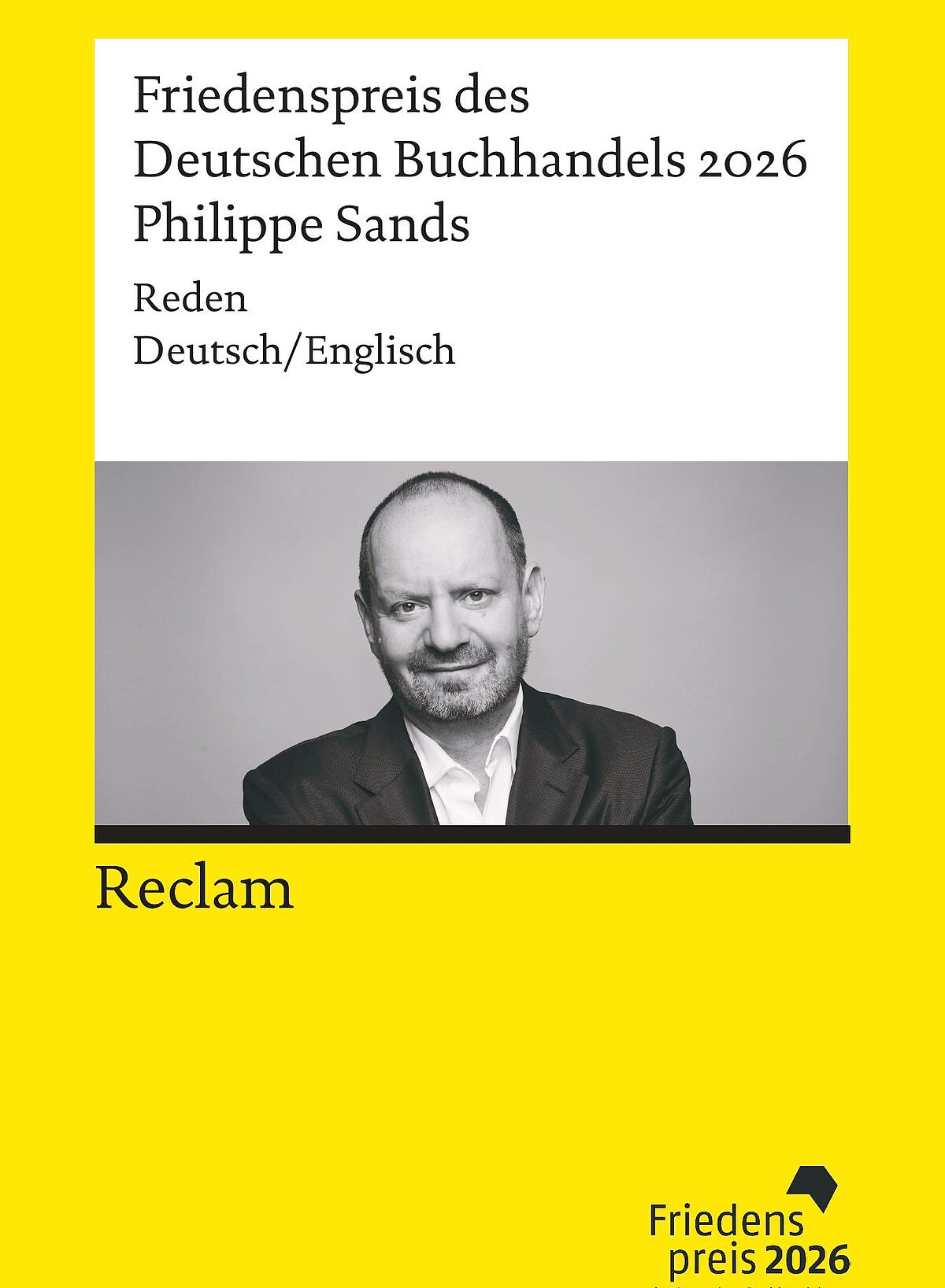
Friedenspreis des Deutschen Buchhandels 2026 – Philippe Sands
Ansprachen aus Anlass der Verleihung. Deutsch/Englisch
Hrsg. vom Börsenverein des Deutschen Buchhandels
im Reclam Verlag, Stuttgart 2026,
Originalausgabe, Reclams Universal-Bibliothek, 88 Seiten, 10,00 €
ISBN 978-3-15-014840-2
Erscheint am 11. 11. 2026
Bibliography
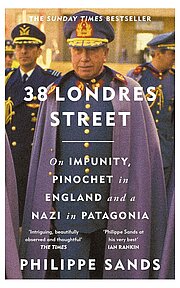
»38 Londres Street: On Impunity, Pinochet in England and a Nazi in Patagonia«
Weidenfeld and Nicolson, London, 2025, 480 pp. ISBN 9781474620741
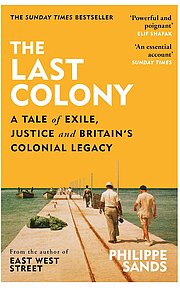
»The Last Colony: A Tale of Exile, Justice and Britain’s Colonial Legacy«
Weidenfeld and Nicolson, London, 2022, 224 pp. ISBN 9781474618120
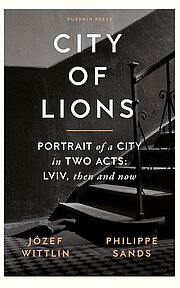
»City of Lions: Portrait of a City in Two Acts: Lviv, Then and Now«
By Philippe Sands and Józef Wittlins, translated into English by Antonia Lloyd-Jones. Pushkin Press, London, 2023, 158 pp. ISBN 9781805330011
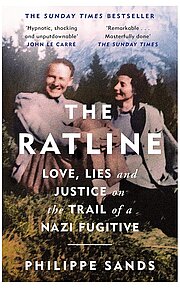
»The Ratline: Love, Lies and Justice on the Trail of a Nazi Fugitive«
Weidenfeld and Nicolson, London, 2020, 432 pp. ISBN 9781474608145
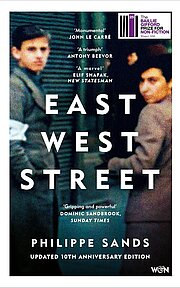
»East West Street: On the Origins of Genocide and Crimes against Humanity«
Hachette, London, 2016, 464 pp. ISBN 9780525433729
»Torture Team: Rumsfeld’s Memo and the Betrayal of American Values«
St. Martin’s Press, New York, 2008, 272 pp. ISBN 9780230603905
»Lawless World: America and the Making and Breaking of Global Rules from FDR’s Atlantic Charter to George W. Bush’s Illegal War«
Viking Press, New York, 2005, 324 pp. ISBN 9780670034529
»Chernobyl: Law and Communication: Transboundary Nuclear Air Pollution - The Legal Materials«
Cambridge University Press, Cambridge, 1988, 320 pp. ISBN 9780949009227
Edited Volumes
»International Law and Developing Countries: Essays in Honour of Kamal Hossain« Sharif Bhuiyan, Philippe Sands and Nico Schrijver (eds.). Brill, Leiden, 2014, 414 pp. ISBN 9789004204911
»An International Bill of the Rights of Man« Sir Hersch Lauterpacht. With an introduction by Philippe Sands. Oxford University Press, Oxford, 2013, 260 pp. ISBN 9780199667826
»The Manual on International Courts and Tribunals« (2nd edition), Ruth Mackenzie, Cesare PR Romano, Yuval Shany and Philippe Sands (eds.). Oxford University Press, Oxford, 2010, 500 pp. ISBN 9780199545278
»Selecting International Judges: Principles, Process, and Politics« Ruth Mackenzie, Kate Malleson, Penny Martin and Philippe Sands (eds.). Oxford University Press, Oxford, 2010, 256 pp. ISBN 9780199580569
»Bowett’s Law of International Institutions« (6th Edition), Pierre Klein and Philippe Sands (eds.). Sweet & Maxwell, London, 2009, 619 pp. ISBN:9780414050570
»Documents in EC Environmental Law« (2nd Edition), Paolo Galizzi and Philippe Sands (eds.). Cambridge University Press, Cambridge, 2006, 988 pp. ISBN: 9780521833035
»From Nuremberg to the Hague: The Future of International Criminal Justice« Philippe Sands (ed.). Cambridge University Press, Cambridge, 2003, 206 pp. ISBN 9780521536769
»Justice for Crimes against Humanity« Mark Lattimer and Philippe Sands (eds.). Hart Publishing, Oxford, 2003, 528 pp. ISBN 9781841134130
»Documents in International Environmental Law« (2nd Edition), Paolo Galizzi and Philippe Sands (eds.). Cambridge University Press, Cambridge, 2004. ISBN 9781139 171380
»Environmental Law, the Economy and Sustainable Development: The United States, the European Union and the International Community« Richard Stewart, Philippe Sands and Richard Revesz (eds.). Cambridge University Press, Cambridge, 2000, 448 pp. ISBN 9780521642705
»International Law, the International Court of Justice and Nuclear Weapons« Laurence Boisson de Chazournes and Philippe Sands (eds.). Cambridge University Press, Cambridge, 1999, 592 pp. ISBN 9780521654807
»Principles of International Environmental Law« Jacqueline Peel and Philippe Sands (eds.). Manchester University Press, Manchester, 1995 (1st edition), Cambridge University Press, Cambridge, 2018 (4th edition), 1032 pp. ISBN 9781108420952
»Greening International Law« Philippe Sands (ed.). Routledge, London, 1993, 286 pp. ISBN 9781138471689
»The Antarctic and the Environment« Joe Verhoeven, Philippe Sands and Maxwell Bruce (eds.). Graham & Trotman, London, 1992, 228 pp. ISBN 9781853336300
Laudation Mirjam Zadoff
Mirjam Zadoff was born in 1974 in Innsbruck, Austria. After earning her doctorate and completing her habilitation in history and Jewish studies in Vienna and Munich, she was a professor of these subjects at Indiana University Bloomington from 2014 to 2019. She then worked as a visiting professor at universities in Zurich, Berkeley and Berlin. She is currently an honorary professor at the Technical University of Munich and an adjunct professor at Ludwig Maximilian University in Munich. In May 2018, she became director of the Munich Documentation Center for the History of National Socialism (nsdoku), where she oversees exhibitions, educational and outreach programmes, and innovative digital projects. She is also responsible for developing the nsdoku as a site for engaging with the history of the Nazi era.
Zadoff is the author and editor of numerous books and exhibition catalogues, including Gewalt und Gedächtnis: Globale Erinnerung im 21. Jahrhundert (Violence and memory: Global memory in the 21st century, 2023). She serves on various boards and committees, including the Bavarian Academy of Sciences, and has received numerous honours, including the Bavarian Order of Merit (2023) and the Thomas Dehler Prize (2024). Zadoff has been a member of the Peace Prize’s Board of Trustees since February 2026.